



SEO & GEO for Websites
Perxel builds the page structure around what your clients actually search for, so Google ranks it and AI tools like ChatGPT and Gemini read and cite it correctly. Handed over with a 100 SEO score in PageSpeed, on your current site or a new one.
Before a page can rank, Google has to read it: what it is about, which group of content it belongs to and which other pages it relates to. AI tools like ChatGPT, Gemini and Google's AI Overviews read a site the same way before they cite it. That work lives in the code and the page structure, so we do it while we build, on WordPress and Next.js alike.
What we commit to at handover
A 100 SEO score in PageSpeed at handover
The homepage, service pages, product pages and articles are all checked with Lighthouse on mobile and desktop before handover. Measured on 13 October 2026 with Lighthouse 12, perxel.com, Khatra Tile, Sundmd, Foldables and Atlas Robotics all scored 100 for SEO on both mobile and desktop.
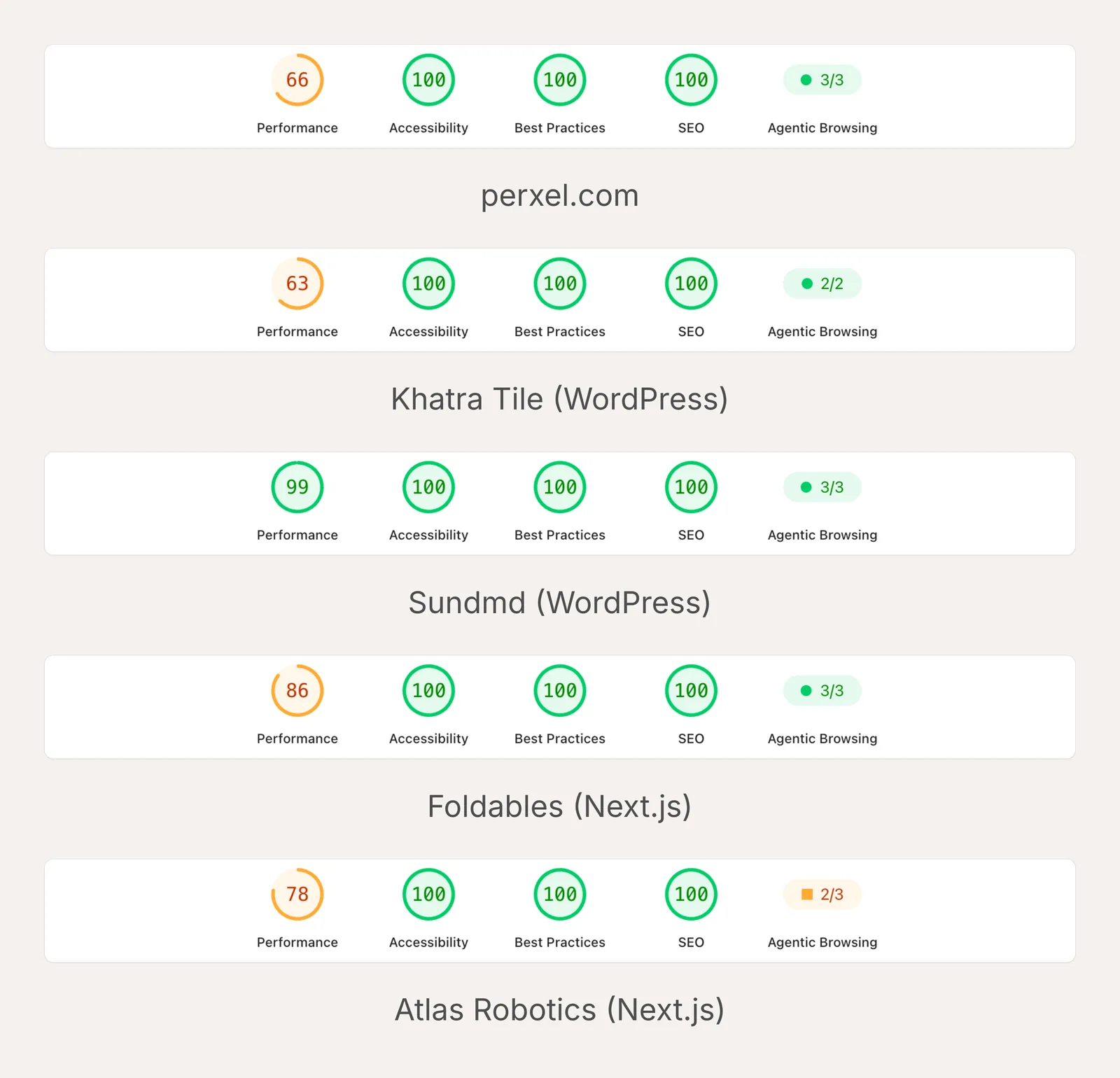
PageSpeed Insights on mobile for five sites built by Perxel, measured 13 October 2026.
Two parts of the score are written by whoever edits the content after handover: image descriptions (alt text) and link text. So we make alt text a required field in the CMS, and the score holds as new posts go in.
Page structure built around what clients search for
We map the pages before we write any code: each page targets one main search term, and related pages link to each other in the order a reader needs them. Google understands which topics the site covers, and readers move from page to page along a clear path instead of going back to the homepage.
Structured data for Google and AI
Business details, address, products, articles and breadcrumbs are declared as structured data (JSON-LD). Multilingual sites get hreflang tags so Google shows each reader the right version. An llms.txt file also summarises the site so AI tools can read its main content quickly.
GEO: getting AI tools to read and cite your site
GEO (Generative Engine Optimization) is the work that helps ChatGPT, Gemini, Perplexity and Google's AI Overviews read your content correctly and mention it in their answers. The technical SEO above is the foundation; on top of it we do four things:
- Let AI bots in. We check
robots.txt, Cloudflare and hosting settings so GPTBot, ClaudeBot and PerplexityBot aren't blocked or rate-limited without you knowing. Many hosting plans and firewalls ship with rules that block bots, so this needs checking on every site. - Write content AI can quote. Each page answers its main question in the first paragraph, with clear headings, an FAQ section, and figures that carry a date and a source.
- A source for machines. Beyond JSON-LD and llms.txt, a Next.js site can also publish a JSON feed or an MCP server. Our own site uses that same source for Ask Perxel, the assistant that answers visitors.
- Measure traffic from AI. Visits from chatgpt.com, perplexity.ai and gemini.google.com get their own channel in Google Analytics, so you can see whether GEO brings in visitors.
Your current site or a new one
If your current site can still be worked on, we keep it. On Khatra Tile, a WordPress site more than 10 years old with close to 800 products, we rewrote the whole theme but kept every URL, so rankings for the key search terms in the tile industry held steady after the new design launched.
- WordPress sites. We configure Rank Math or Yoast SEO and fix the parts of the theme the plugin can't reach. Khatra Tile uses Rank Math to declare the business address and coordinates, in Vietnamese and English. Sundmd uses Yoast SEO for breadcrumbs and an automatic llms.txt.
- Next.js sites. Metadata, the sitemap, structured data and llms.txt are written in code, so they always match what is in the CMS. Our own site also has a JSON feed and an MCP server, so AI tools can read the full content without guessing from the layout.
How we work
- Audit the current site. Measure the SEO score and check the sitemap, canonical URLs, structured data, which pages Google has indexed in Search Console, and whether AI bots can reach the site.
- Map pages and search terms. Each page gets one main search term, a clear purpose and a list of the pages it links to. You approve the map before we start on the code.
- Build. Adjust page structure, metadata, structured data and internal links on your current site, or build a new one from the approved map.
- Test and hand over. Run Lighthouse on every page type, submit the sitemap to Google Search Console and show your content team how to keep these checks passing when they publish.
Every site has its own size and starting point, so we send a quote after the first audit.
Scope
We handle the technical foundation and the structure of the site. Ongoing content writing and link building aren't part of this service. Rankings on Google and citations by AI tools also depend on content, competitors and time, so we don't promise a specific ranking.
FAQ
Further reading
- PageSpeed Insights & Core Web Vitals
- The SEO score in PageSpeed
- GEO: helping ChatGPT and Gemini read your website
- Next.js & Headless CMS websites
- WordPress custom theme development
Contact Perxel
Footnotes
Want a quote?
Get in touch with Perxel today.